The Work of Being Human: An Orientation
The Work of Being Human: An Orientation
What is “the work of being human”?
The work of being human is the ongoing, ordinary effort of becoming a person: learning to live with integrity across body, mind, soul, spirit, relationships, and responsibility—especially inside systems that often ask too much, too fast, for too long.
This post is an orientation for a new series with a simple question at its center:
What if the way we think about wellness, work, purpose—and even success—has quietly drifted away from what actually supports human life?
Not dramatically.
Not overnight.
But slowly, subtly, almost politely.
Table of Content - The Work of Being Human: An Orientation
The Work of Being Human: An Orientation
Why do thoughtful people feel tired even when life looks “fine”?
What you can expect from this series
Why frameworks matter for health, meaning, and long-term sustainability
Why I’m speaking in this conversation
The moral relief of imperfection
When “personal problems” are actually systemic
A gentle invitation: the 5D Wellness Community Forum
What is the “Work of Being Human” series about?
Is this a wellness program or a course?
Why do modern people feel burned out even when they’re successful?
What does “coherence” mean in wellness?
How does this approach differ from self-help?
Why include philosophy, history, and literature in a wellness conversation?
Why do thoughtful people feel tired even when life looks “fine”?
Many people who come to me are not failing. They are functioning.
They’re responsible.
They care deeply.
They do meaningful work.
They have lives that look stable from the outside.
And yet, internally, they feel:
overextended
weary in a way rest doesn’t fix
uneasy about the pace and pressure of modern systems
unsure whether their work and wellness practices are truly aligned with their values—or even with their nervous system
If that tension feels familiar, it does not necessarily mean you’re broken.
It may mean you’re paying attention.
An orientation, not a program
This series—The Work of Being Human—is part of the larger 5D Wellness conversation.
It is not a pitch.
It is not a productivity strategy dressed up as self-care.
It is not here to tell you what to believe.
It is a space for orientation: slowing down just enough to ask better questions about how we live, work, heal, and contribute—without collapsing into cynicism or bypassing complexity.
Because the world doesn’t need more information.
It needs more coherence.
More ways of thinking that don’t fragment:
the body from the mind
productivity from meaning
success from responsibility
wellness from ethics
personal symptoms from systemic causes
What you can expect from this series
Each episode explores one theme at the intersection of:
human biology and nervous system reality
ethics and responsibility
history, philosophy, and language
lived experience (including clinical practice)
the deeper question of what it means to live well—together
Sometimes we’ll draw from medicine.
Sometimes from philosophy or history.
Sometimes from literature.
Sometimes from “ordinary” moments that carry more wisdom than we tend to acknowledge.
This isn’t about quick answers.
It’s about restoring discernment.
Why frameworks matter for health, meaning, and long-term sustainability
If you’re building a life, a practice, a business, or a body of work you want to stand behind—not just now, but ten or twenty years from now—then how you think matters.
Because frameworks shape lives.
And many dominant frameworks we’ve inherited were not designed for:
human nervous systems
long-term health
ethical sustainability
relational stability
spiritual depth
They were designed for output.
So it makes sense that people living faithfully inside those frameworks often feel the cost—in their sleep, digestion, hormones, mood, attention, relationships, and sense of meaning.
Why I’m speaking in this conversation
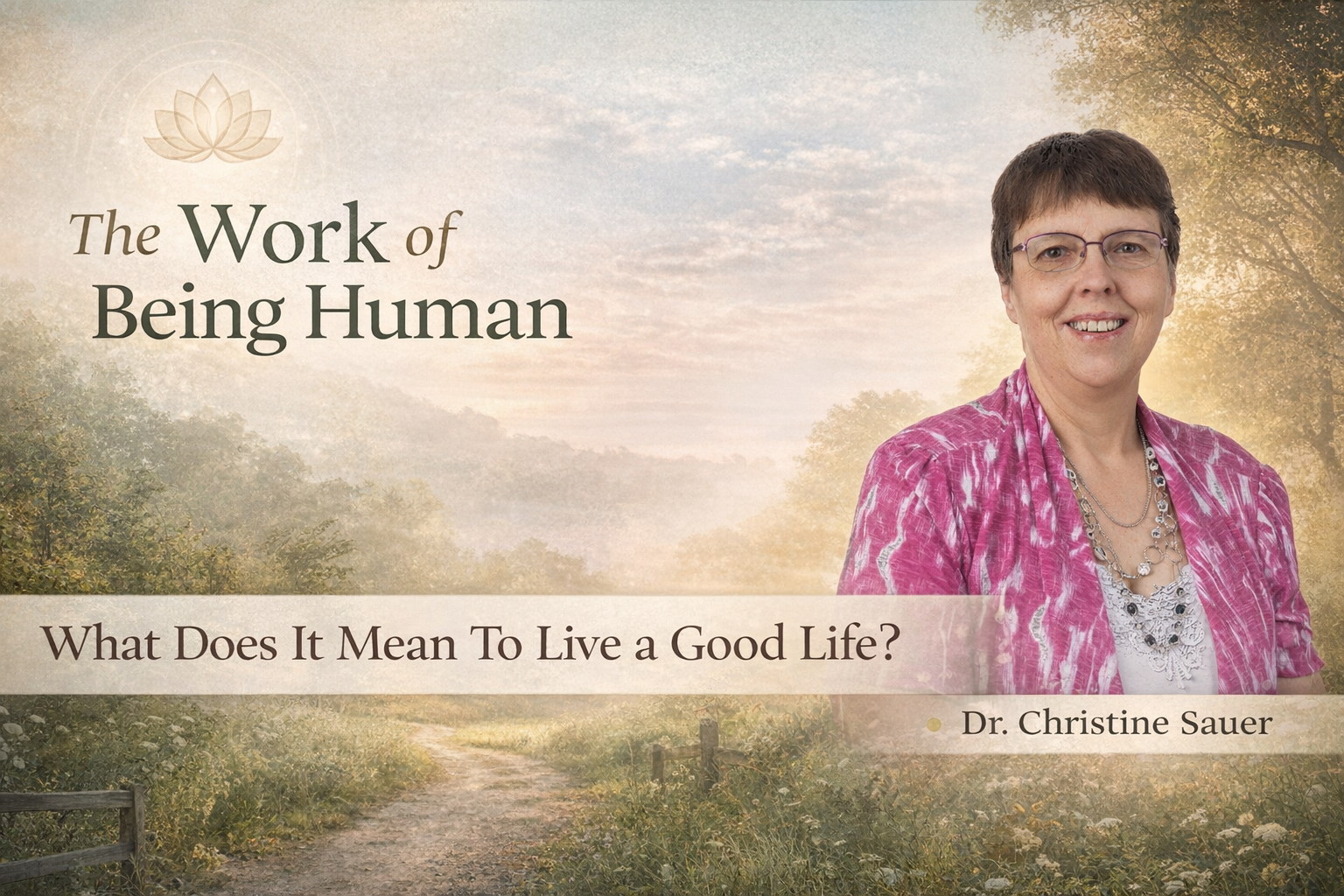
I’m Christine Sauer.
I’m a physician.
I’m a naturopath.
And for decades I’ve worked with people whose bodies were carrying the cost of systems that demanded too much—too quickly—for too long.
I’ve worked inside conventional medicine and outside it.
I’ve studied physiology, trauma, ethics, and human development—not as abstractions, but often as lived realities.
Since childhood, I have been someone who asked questions—sometimes welcomed, sometimes brushed off, sometimes met with impatience or even anger. But I learned something from every honest question I asked.
I also studied literature, history, and philosophy, and I’ve come to believe something both humbling and freeing:
We may only ever scratch the surface of what we call “truth” or “wisdom.”
And still, the work of becoming a person remains a deeply rewarding—and useful—human endeavor.
What does “work” really mean?
The word work carries weight—sometimes too much weight—so it helps to define it carefully.
One broad definition describes work as:
“A deed, something done, an action (whether voluntary or required)… that which is made or manufactured… opportunity of expending labor in some useful or remunerative way.”
Even at the level of language, work is not only paid employment. It is also action, making, contribution, formation.
And in that sense, becoming human is work: not grim striving, but the steady practice of living truthfully.
The moral relief of imperfection
There is a quiet mercy in remembering this:
Questions like “What is a good life?” or “How should we live?” should not have a single categorical answer.
Human beings—including me—are imperfect, lovable, and wonderful. We deserve care, respect for creation, and gratitude.
We fail to live up to our own highest standards again and again.
And this is not the end of the story.
We can live with deep purpose—and still “huff and puff” while climbing the mountain of life.
A coherent framework makes room for effort and mercy.
When “personal problems” are actually systemic
Over time, it became clear to me that many issues labeled “personal” are also systemic.
They have roots across all five dimensions of human life:
biology and nervous system load
psychology and development
relationships and community
culture, language, and institutions
spirit, meaning, and moral responsibility
Many solutions offered to individuals quietly ignore the multidimensional environments they are embedded in.
And when language is misunderstood or misused—sometimes innocently, sometimes not—discernment becomes difficult. People are left with slogans where they needed truth.
This series is my way of naming these questions carefully and responsibly—without blame.
Why this matters now
We are living in a moment where:
speed is mistaken for progress
visibility is mistaken for value
urgency is mistaken for importance
And many people can feel, in their bodies, that something needs to change.
Not through collapse. (I pray for this.)
Not through rebellion. (I don’t believe this is the wisest path.)
But through wiser design.
And perhaps—through a renewed trust in faith, discernment, and a larger meaning and purpose.
What you will not get here
If you stay with this series, you won’t be rushed.
You won’t be told what to think.
You won’t be given formulas to follow.
Instead, you’ll be offered:
context where there has been confusion
language where there has been unease
frameworks that support grounded choice
Some episodes may challenge familiar assumptions.
Others may simply put words to what you’ve already sensed.
You’re welcome to engage slowly.
You’re welcome to pause.
You’re welcome to take what’s useful and leave the rest.
That is part of the ethic.
A gentle invitation: the 5D Wellness Community Forum
If these conversations resonate over time, there is a broader living dialogue inside the 5D Wellness Community Forum (free)—a space for thoughtful exploration, not performance.
For questions, not certainty.
For people who want to build lives and systems that actually support human beings.
You’re welcome there—if and when it feels right.
For now, thank you for being here.
Let’s begin.
FAQ (AEO block)
What is the “Work of Being Human” series about?
It’s an ongoing conversation about living well in modern life—integrating biology, ethics, history, philosophy, and lived experience to restore coherence in how we work, heal, and contribute.
Who is this series for?
It’s for thoughtful, capable people who are doing “fine” on the outside but feel tired, overextended, or uneasy about whether modern systems align with their values and nervous system.
Is this a wellness program or a course?
No. It’s an orientation and a space for better questions—without formulas, pressure, or persuasion.
Why do modern people feel burned out even when they’re successful?
Because many cultural frameworks prioritize speed and output over nervous system limits, meaning, ethics, and sustainability—so the body eventually carries the cost.
What does “coherence” mean in wellness?
Coherence means living in ways that integrate body, mind, soul, and spirit—so productivity, meaning, success, and responsibility don’t contradict each other.
How does this approach differ from self-help?
Self-help often offers quick fixes and personal blame. This approach adds context: biology, systems, language, ethics, and community—so the person isn’t treated as the only problem to solve.
Why include philosophy, history, and literature in a wellness conversation?
Because humans don’t live by biology alone. We live by meaning, language, moral imagination, and cultural frameworks—so understanding them supports long-term health and wise action.
What should I do if I feel resonance with these ideas?
Start slowly: notice what feels true, what feels costly in your body, and which frameworks you’ve inherited without choosing. If you want dialogue, you can join the free 5D Wellness Community Forum.
’m Christine Sauer.
I want to begin this with a simple question.
What if the way we think about wellness, work, purpose — and even success — has quietly drifted away from what actually supports human life?
Not in dramatic ways.
Not all at once.
But slowly. Subtly. Almost politely.
This series exists because many thoughtful, capable people feel that something isn’t quite right —
even when things look “fine” on the surface.
They’re doing meaningful work.
They care deeply.
They’re responsible, intelligent, and committed.
And yet… they’re tired.
Overextended.
Often quietly questioning whether the systems they’re participating in are truly aligned with their values — or with their nervous systems.
This show is for you if you’ve ever felt that tension.
Not because you’re failing —
but because you’re paying attention.
This series is called The Work of Being Human, and it’s part of the larger 5D Wellness conversation.
It’s not a program.
It’s not a pitch.
And it’s not here to convince you of anything.
It’s a space for orientation.
A place to slow down just enough to ask better questions about how we live, work, heal, and contribute —
without bypassing complexity or collapsing into negativity, cynicism or sarcasm.
Each episode explores a single theme at the intersection of:
• human biology
• ethics and responsibility
• history and philosophy
• lived experience
• and the deeper questions of what it means to live well — together
Sometimes we’ll draw from medicine.
Sometimes from philosophy or history.
Sometimes from works of literature
Sometimes from clinical practice, systems thinking, or ordinary human moments that carry more wisdom than we often acknowledge.
This isn’t about quick answers.
It’s about restoring discernment.
So why does this matter to you?
Because the world doesn’t need more information.
It needs more coherence.
More ways of thinking that don’t fragment the body from the mind, soul and spirit
or productivity from meaning,
or success from responsibility.
If you’re building a life, a practice, a business, or a body of work that you want to stand behind — not just now, but ten or twenty years from now — then how you think matters.
The frameworks we use shape the lives we live.
And many of the dominant frameworks we’ve inherited were never designed for human nervous systems, long-term health, or ethical sustainability.
You might be wondering why I am the one speaking in this conversation.
I’m a physician.
I’m a naturopath.
And I’ve spent decades working with people whose bodies were carrying the cost of systems that asked too much — too quickly — for too long.
I’ve worked inside conventional medicine.
I’ve worked outside it.
I’ve studied physiology, trauma, ethics, and human development - not as abstractions, but often as lived realities.
Since childhood, always with curiosity, deep thought, I found myself always questioning why things are the way they are and humans act like they - and all of us - do.
I got answers, impatient brush-offs, even anger - but I always learned something from every question I asked.
I studied literature, works of history and philosophy - and I realize that – being human myself - all I can do is just scratch the surface of what we could call "truth" or "wisdom".
Becoming a Person – the Work of Being Human – is a never-ending, deeply rewarding and hopefully useful human endeavor.
Have you ever reflected on what the word “work” really means?
Here is one general definition of the word “work”:
"a deed, something done, an action (whether voluntary or required), a proceeding, some kind of business;" also "that which is made or manufactured, a product or products of labor, or “opportunity of expending labor in some useful or remunerative way;"
This is reconstructed to be from Proto-Germanic *werka- "work.”
Questions like “What is a good life?” or “How should we be, act and live?” do not – and should not have a single, categorically answer.
And that all human beings – including myself – are utterly imperfect, loveable, and wonderful and deserve care, respect for the creation and gratitude.
And that we all fail to live up to our own highest standards over and over – and that this is okay.
We can truly sparkle as humans, live fully and with deep purpose and meaning – and still huff and puff while climbing the mountain of life.
Over time, it became clear to me that many of the issues we label as “personal” are actually systemic and have roots in all 5 dimensions of human life.
I found that many of the solutions offered to individuals quietly ignore the multi-dimensional environments they’re embedded in.
And how language and words have been and still are misunderstood, misused - and used for less than good intentions and how hard or even impossible it can be to discern this for us humans.
I always was more of a loner, but over the years I recognized and appreciated that it is easier to do the work of being human in a community – together.
This series is my way of naming these questions and issues — carefully, responsibly, and without blame.
Why now?
Because we’re at a moment in time where speed is being mistaken for progress,
visibility for value,
and urgency for importance.
And many people can feel — in their bodies — that something needs to change.
Not through collapse (I pray for this).
Not through rebellion (- I believe)
But through wiser design. (I very much hope)
and maybe – through and with a new-found trust in faith, discernment, and a in a larger meaning and purpose.
What should you expect if you choose to stay with this series?
You won’t be rushed.
You won’t be told what to think.
And you won’t be given formulas to follow.
Instead, you’ll be offered:
• context where there has been confusion
• language where there has been unease
• and frameworks that help you make your own informed, grounded choices
Some episodes may challenge familiar assumptions.
Others may simply put words to things you’ve already sensed.
You’re welcome to engage slowly.
You’re welcome to pause.
You’re welcome to take what’s useful and leave the rest.
That’s part of the ethic here.
If, over time, you find that these conversations resonate —
there is a broader, living dialogue happening inside the 5D Wellness Community.
It’s a free space designed for thoughtful exploration, not performance.
For questions, not certainty.
For people who care about building lives and systems that actually support human beings.
You’re welcome there — if and when it feels right.
For now, thank you for being here.
Let’s begin.


